← Back to Engineering Insights
When the Black Box Stops Being a Shortcut
On Python, third-party libraries, abstraction, and the point where convenience turns into architectural dependency.

There is a particularly satisfying moment in software development.
You install a library, write a few lines of code, and a problem that looked like a small project yesterday is suddenly solved.
Need image recognition? There is a package. Parse a document? Package. Draw a chart? Package. Connect to an external system? Someone has probably written a wrapper already.
Python makes this feeling especially vivid. A handful of high-level lines can sit on top of a remarkable amount of C, C++, system libraries, drivers, runtime machinery, and other people's very late evenings.
And that is wonderful.
Until the first question changes from 'Can we do this?' to 'Why does it behave like that?'
That is usually when the black box stops being a shortcut.
High-level abstraction is not the problem
This is not an argument against Python, third-party libraries, frameworks, or abstraction. Quite the opposite.
Abstraction is one of the reasons we can prototype quickly, automate processes, analyze data, and test technical ideas without rebuilding civilization from first principles every Monday morning.
If a mature library solves a problem better than we can reasonably solve it ourselves, writing our own replacement for the sake of purity is an expensive form of engineering vanity.
The problem does not begin when we use someone else's code. It begins when we stop understanding which part of our system's behavior we have handed over to it.
The less code you wrote, the more code somebody else wrote
If your solution takes five lines, that does not mean the system now contains five lines.
The complexity has probably moved somewhere else: into a library, a runtime, an operating-system component, a driver, a cloud service, or a dependency of a dependency.
Occasionally it lives inside a dependency of a dependency of a dependency last updated by a maintainer called silent_penguin_84.
All of it is now part of your system. It simply does not attend your architecture meetings.
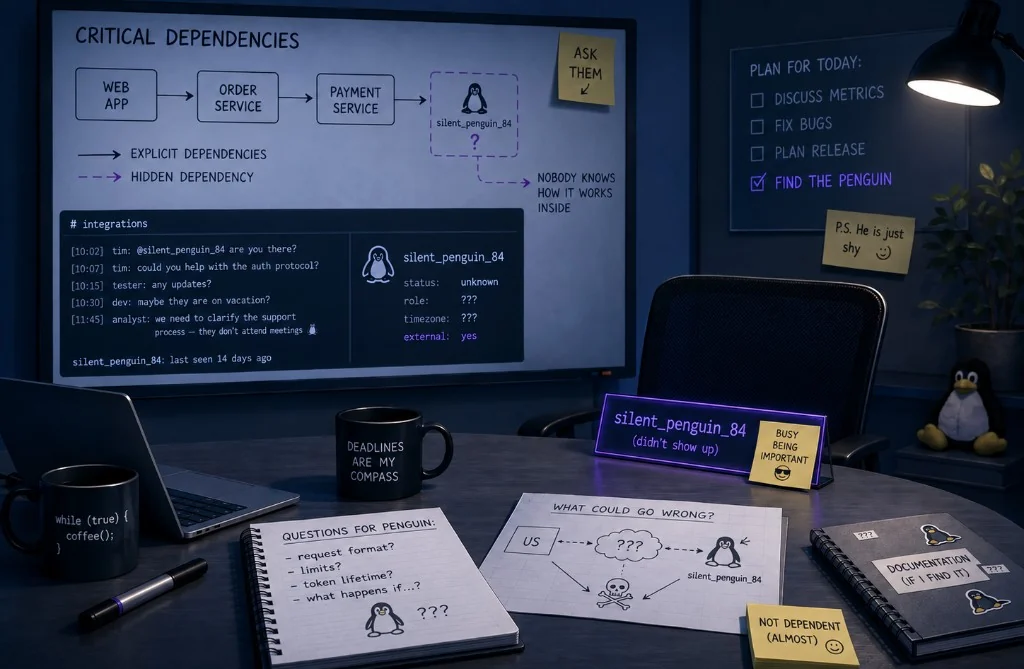
A dependency is called a dependency for a reason.
When we adopt a library, we save time. We also adopt some of its decisions.
If the question is "Can it be done?", the black box is excellent
For a prototype, high abstraction is often exactly what you want.
If the task is to find out whether data can be extracted, an object can be recognized, two systems can be connected, or a calculation model works at all, there is little value in starting by writing a custom low-level engine.
The first question is simple: does the hypothesis work?
Python, mature packages, and high-level tools are extremely good at answering that quickly. In a day, you can test something that might take a week if you insist on making it production-grade before you know whether the idea deserves to survive.
But prototypes and production systems ask different questions.
A prototype asks: "Can this work?" Production asks: "What happens if this runs for five years, 24/7, on real data, after the original author has disappeared into another project?"
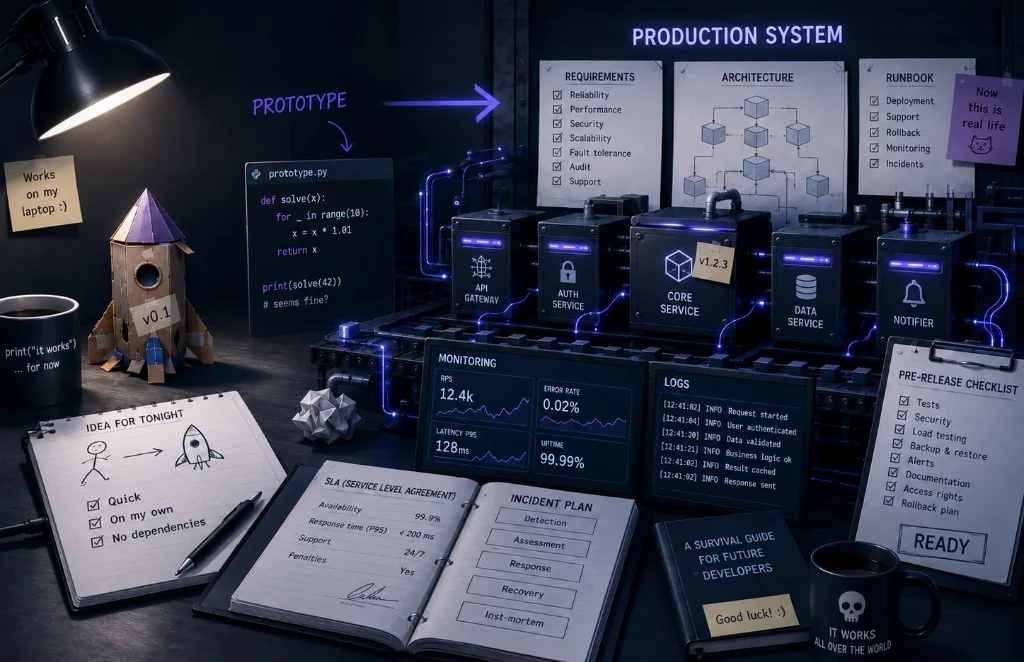
Eventually the black box grows a lid
Sooner or later, details that did not matter during the prototype start to matter a lot:
- What happens to memory under sustained load?
- How does the component behave on large datasets?
- Are there hidden locks or thread limitations?
- How are errors handled and retried?
- Is operation ordering guaranteed?
- Is the result reproducible?
- What changes after an upgrade?
- Who maintains the package and how actively?
- What license obligations come with it?
- Can a version be pinned for years?
- What is the security model?
- What other dependencies arrive with it?
Yesterday it was a convenient function. Today it is part of the architecture.
Black boxes are especially attractive until smoke starts coming out. After that, everybody develops a sudden and healthy interest in what is inside.
"It works" and "it works predictably" are different requirements
For an internal script, completing the task may be enough.
For an engineering system, that can be nowhere near enough.
If software controls equipment, participates in a production process, handles large volumes of data, or is expected to live for years, the behavior itself becomes part of the requirement: execution time, memory consumption, latency predictability, recovery after failure, diagnostics, reproducible builds, and maintainability without the original dependency author standing nearby.
In that environment, 'the library does it internally' is no longer a technical explanation.
It is simply the address of the next question.
Python is not guilty. It just demonstrates the principle very clearly
Python is useful precisely because it hides an extraordinary amount of machinery. It lets us think in terms of intent: load data, transform a table, call a model, send a request, receive a result.
That is a tremendous strength.
But the higher the abstraction, the more behavior lives below the visible boundary.
A one-line sort still runs an algorithm. An image-processing call still allocates memory and executes native code. A machine-learning package still depends on numerical libraries, drivers, and particular hardware behavior.
Abstraction removes complexity from view. It does not remove complexity.
The dangerous mistake is to confuse simple code with a simple system
From the outside, a solution may look beautifully small: get data -> call library -> return result.
Three steps.
Inside those three steps may be network calls, caches, queues, serialization formats, native modules, retry policies, and several layers of dependencies.
We have produced simple code. We have not necessarily produced a simple system.
Did we actually reduce complexity, or did we just move it somewhere less visible?
Moving complexity out of sight is often exactly the right thing to do. Most modern software would be impossible otherwise. The question is whether the hidden complexity remains manageable.
A third-party library is not just code
When we adopt a library, we also adopt its architectural choices, limitations, bugs, release cadence, attitude toward backward compatibility, security model, and license.
And sometimes, less formally, the energy level of the person maintaining it after work in the evenings.
That last factor rarely appears on architecture diagrams, but reality has never been especially respectful of diagrams.
So the useful question is not only, 'Is there a library for this?' It is also, 'What responsibility are we handing over with it?'
That is not an argument against dependencies. It is an argument for choosing them deliberately.
We add a library in two minutes. Sometimes we remove it in two months
Installing a package is easy. At the beginning it looks like a minor implementation detail.
Then our interfaces, data formats, error handling, tests, and integrations grow around it. Several years later, replacing the library turns out to be harder than adopting it ever was.
That does not mean the original decision was wrong. But it does mean we should know where the dependency sits: at the edge of the architecture, or at its center.
Replacing a helper function and replacing the foundation of your data model are very different engineering projects.
Where black boxes are perfectly appropriate
There is a large class of work where opening the box is unnecessary: prototypes, research, analytics, internal tools, process automation, data processing, non-critical integrations, and systems with a short expected lifetime.
In those cases, delivery speed often matters more than owning every layer.
Replacing a mature library with custom code because 'an engineer should understand everything' is not engineering rigor. It is usually just expensive.
And where abstraction has to come down a level
The balance changes when the system requires predictable execution time, constrained memory, close interaction with hardware, a long service life, strong security, certification, reproducibility, precise failure diagnostics, unusual protocols, or independence from a vendor.
Then some black boxes need to be opened.
Sometimes reading the implementation and pinning the version is enough. Sometimes the dependency should be isolated behind an adapter. Sometimes a component needs to be replaced. Sometimes a small custom implementation is justified.
And sometimes, after careful inspection, the conclusion is that the library is excellent and the lid can be closed again.
That is also a perfectly respectable engineering result.
Your own code can be an excellent black box too
It is important not to swing to the opposite extreme.
Code does not become transparent simply because your team wrote it.
A third-party library may be better tested, better documented, and more widely used than an internal component written three years ago by someone who has since left software engineering and is, by all accounts, much happier.
So the real choice is not 'external is dangerous, internal is safe.'
Understood and manageable is better than unknown and unmanageable.
Who wrote the code is secondary.
AI makes the subject more interesting
Previously, a developer at least selected the library and usually had some idea why it entered the project.
Now an AI system can assemble a working solution from several packages in minutes. This is extremely useful.
It also creates a new architectural style: a system made of dependencies that appeared because they were the fastest path to a green result.
The system may work beautifully. The engineer still has to ask why each dependency exists, what function it owns, whether it can be replaced, what risks it introduces, and what happens if it disappears or changes.
AI can accelerate assembly. It does not remove the need to understand what has been assembled.
Good engineers do not avoid black boxes
They know which ones can safely remain closed.
Nobody needs to inspect every machine instruction. But treating a dependency like a magic spell - import miracle - is not a durable architecture either.
If the hidden behavior does not affect your requirements, excellent. Leave the box closed.
If it starts affecting them, it is time to lift the lid. Sometimes literally. More often architecturally.
In the end, this is not a language debate
It is not Python versus C#. It is not high-level versus low-level. It is not custom code versus third-party code.
The real question is: how much control does this particular system require?
The answer will be different for a prototype, an internal automation tool, a ten-year industrial system, and a safety-related component close to hardware.
Abstraction is a powerful engineering tool. Its price is that some control moves below the boundary we can see.
Mature engineering does not begin with the desire to write everything ourselves. It begins with knowing which complexity can stay hidden - and which complexity we will eventually have to understand.
A good engineer does not avoid black boxes. A good engineer knows which ones will eventually need to be opened.
Or, more briefly: abstraction hides complexity. It does not cancel it.